
GLOBAL RESEARCH
The ROI of Gen AI and Agents 2026
With agents, early adopters are building on gen AI success
Researchers at Omdia surveyed 2,050 professionals worldwide who are actually driving the strategy, rollout and optimization of AI systems. Their global research uncovered:
- The rising ROI of gen AI — up 20% year over year
- The key challenges that trouble even successful organizations
- The early moves, and rising sentiment, around AI agents

GEN AI ADOPTION RISES, AND SO DOES THE ROI
Amid all the back-and-forth about the value of generative AI, organizations report success.
- 92% of early adopters say they’ve seen a positive return on their gen AI investments.
- 75% of C-level respondents for nontechnical business orgs report a positive, quantified ROI.
- 96% reported that they grapple with significant issues, led by data quality and quantity (40% of orgs), employee skills (35%) and integration with existing systems (31%).
Bottom line: Organizations tell us gen AI is working, their investments are continuing and the ROI is there.
40%
Respondents who quantified their ROI on gen AI report earning $1.49 for every $1 invested.
COMING UP FAST:ENTERPRISE AGENTS
While agentic AI solutions are not widespread, and often are not yet very complex, our research shows that agents are already gaining traction among early gen AI adopters:
32% of respondents say they have agentic solutions in production today.
Senior executives expect up to a 47% return on agentic investments in the next 12 months, in line with gen AI results to date.
44% of organizations with multiple gen AI use cases in production are already using agentic AI.
It is not surprising that early adopters of gen AI are taking their learnings to the agentic level. But it is significant that more tech-forward organizations may be opening up a sizable lead over competitors. Download the full report for details.
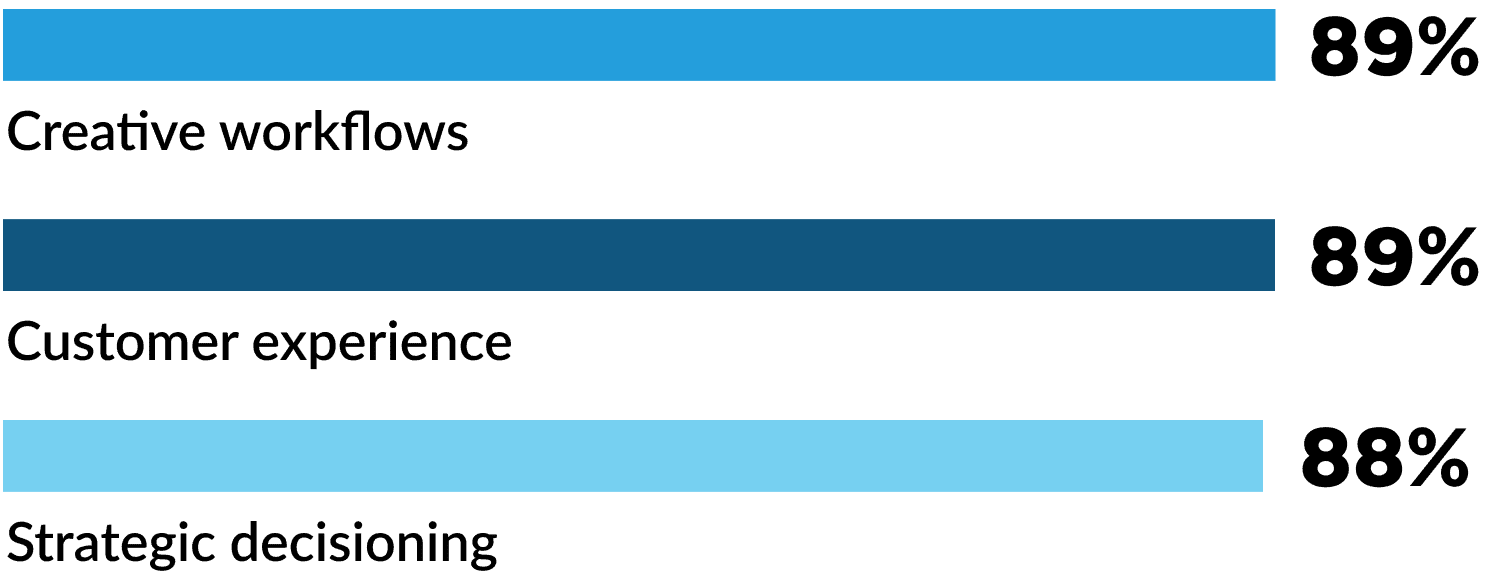
At orgs already using AI agents, the most common uses are:
MIXED SIGNALS ON GEN AI'S EFFECT ON JOBS AND PRODUCTIVITY
An often-feared outcome of generative and agentic AI is that it will eliminate human jobs. And it has. Teams most often experiencing job loss due to gen AI in the past year were IT operations (at 40% of surveyed orgs), customer service/support (37%) and data analytics (37%). But that's not the whole story.
42% of respondents say that gen AI has only created jobs at their organization.
11% responded only that jobs have been lost.
35% report that jobs have both been created and lost due to AI.
13% said that employment had not been affected by AI-powered automation.
See the report for more information on how job impacts affect seniority levels and more.

Share of businesses having seen both AI-related job creation and loss that report a net positive
BEST PRACTICES, WORST PITFALLSEMERGE FROM EARLY ADOPTERS
The pivot to agentic enthusiasm does not mean that gen AI is now child’s play. While nearly every respondent reports that gen AI is returning value, 96% say that they grapple with significant issues, including:
Data quality and quantity (40% of respondents)
Employee expertise or skill (35%)
Integration with existing or legacy systems (31%)
Scalability and performance (27%)
For midsized companies, talent is a bigger challenge: 43% cited it as a problem, compared to 34% of enterprise respondents.

The blissful share of respondents who say they’ve had no problems implementing gen AI
FASTER, SMARTER, BETTER:HOW AND WHERE AI IS WORKING
The most common teams to deploy gen AI and agents are ITOps (62% of respondents), data analytics (59%), cybersecurity (53%), software development (50%) and customer service (49%). The top three drivers behind these deployments are:
Operational efficiency, cited by 51% as a top goal. And 88% of all respondents report material gains.
Better innovation, cited by 44% — with 83% of all respondents saying they’ve seen measurable improvement.
Upleveled CX, cited by 40% who sought better customer experience; 84% of all respondents say they’ve achieved it.
The full report dives into how key business and IT teams are using gen AI, and whether they’re finding success. (Spoiler: They are.)
GLOBAL AND VERTICAL VIEWS:GEN AI SUCCESS IS IN THE DETAILS
We break down highlights from 10 countries and six industries. Top takeaways include:
Canadian organizations are aggressively focused on customer use cases; 54% apply gen AI to customer service and support (versus 48% globally).
French orgs struggle to achieve gen AI ROI, quantifying it at 32%, versus 49% globally.
Financial services firms are more often concerned not with operational efficiency but improved financial performance, cited as a top adoption driver by 44% versus 29% across all other sectors.
Manufacturers were more likely to cite problems with employee skills and experience (41% versus a 34% average).
Read the report for detailed highlights across region and industry, from who has the highest ROI to who’s moving fastest on agents to who sneaks in the most shadow AI.
Download the eBook
Methodology
In preparing to create this report, Omdia by Informa TechTarget conducted a comprehensive online survey fielded between Aug. 13, 2025, and Sept. 17, 2025. All respondents represent organizations with 500 or more employees. About 34% of respondents represent organizations with more than 5,000 employees; 49% represent orgs with 1,000–4,999 employees; and 17% come from companies of 500–999 workers.
The intent of this report, and the research that underpins it, is to better understand the experiences enterprise organizations are having with generative AI technologies. In many regards, this research is a continuation of 2025’s research and report and it spans considerations like LLM use cases, benefits, challenges, ROI, expectations for the future and more. Additionally, it breaks new ground as organizations turn to agentic AI solutions to further automate business processes. Many of these insights can only be gleaned by surveying organizations with real gen AI experience in production. As such, our survey targeted organizations currently using gen AI to augment and execute business processes in production.
However, the research allows us to make observations about how broadly gen AI has been adopted by enterprises to date. Of the 3,479 respondents who started the survey, 59% reported their organization is already using gen AI across many business use cases (39%) or for a few initial use cases (20%). Further, just 2% of respondents reported their organization has no plans or interest in adopting solutions.
These findings show remarkable consistency with the data collected a year ago indicating that gen AI has, to date, resisted the typical boom-bust-recovery adoption cycle endemic to new enterprise technologies. We believe there are two dynamics at play to bolster adoption: users’ integration of gen AI into daily digital experiences and a significant, demonstrable enterprise impact being achieved across multiple use cases. Together, gen AI’s widespread impact on users’ personal lives and the impacts it has had to date on enterprise workers’ efficiency and productivity appear to be helping it resist usage and investment pullbacks typically seen when hype outstrips reality.
The 2,050 adopters who completed the survey were drawn from IT and cybersecurity (49%), software development (16%), data operations (9%) and other lines of business (for example, marketing, customer support, manufacturing, 25%). To qualify, respondents must have reported that they would be influential in their organization’s future AI purchases. A range of seniorities are represented, from C-level executives to senior individual contributors. Additionally, the research includes responses from across the globe, including the United States (41%), Canada (7%), the United Kingdom (7%), France (7%), Germany (7%), Australia and New Zealand (7%), Japan (7%), Singapore (7%) and India (7%). The margin of error for this sample size is +/- 2 percentage points at the 95% confidence level. The totals presented in figures and tables throughout this report may not add up to 100% due to rounding.